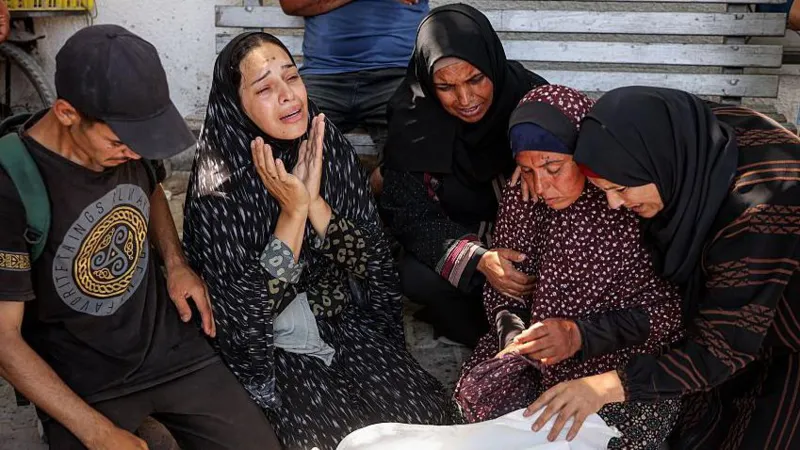
At least 15 Palestinians have been killed by Israeli forces near a humanitarian aid distribution point in central Gaza, according to medical officials at al-Aqsa and al-Awda hospitals.
The victims had gathered near a center operated by the Gaza Humanitarian Foundation (GHF)—a facility located within the Israeli-controlled Netzarim Corridor and reportedly supported by both Israel and the United States. Despite the center being officially closed until Sunday, large crowds remained nearby in hopes of receiving vital food supplies once the site reopens.
The Israeli military (IDF) said its troops fired warning shots at what they perceived as a “potential threat” and confirmed an airstrike was launched at an individual advancing rapidly toward the soldiers. The IDF acknowledged the GHF post was closed and reiterated security concerns, but the incident has sparked renewed outrage over the rising number of civilian deaths linked to aid distribution.
In a separate incident, 12 more people were killed by Israeli fire while waiting for aid along Gaza’s coastal road near al-Shifa Hospital, officials there confirmed. The military says it is “reviewing” reports of the fatalities.
The Hamas-run health ministry said a total of 29 people have been killed in the past 48 hours while seeking humanitarian assistance, pushing the death toll since the GHF began operations two weeks ago to 274.
Adding to the chaos, Gaza’s internet blackout—now in its third day—has made it nearly impossible for civilians to receive real-time updates from the GHF, which typically communicates via Facebook.
Mounting Civilian Risk and Hospital Overload
The continued targeting of aid seekers and the degradation of Gaza’s medical infrastructure are compounding the humanitarian catastrophe.
In southern Gaza, Nasser Hospital in Khan Younis reported at least 16 more deaths overnight due to Israeli airstrikes. The area was previously flagged by the IDF for evacuation, with residents in Abasan, Bani Suhaila, and al-Jadida also ordered to leave immediately. The military said it is acting with “extreme force to destroy terrorist organizations.”
Aid groups have expressed concern that Nasser Hospital, now operating under extreme pressure, may soon lose its ability to function. The International Committee of the Red Cross (ICRC) said about 10% of its staff have left, though earlier reports suggested even higher attrition.
Dr. Feroze Sidwa, working at the hospital, appealed for international intervention:
“If international law has any remaining relevance, Nasser must be protected and resupplied immediately.”
Dr. Victoria Rose, who previously worked at Nasser, emphasized the gravity of the situation:
“This is the only hospital in southern Gaza with intensive care, dialysis, oxygen production, and surgical capability. If it collapses, hundreds will die instantly.”
Broader Context
It has now been 20 months since Israel launched its military campaign in Gaza, following the Hamas-led 7 October 2023 attack that killed 1,200 Israelis and led to the capture of 251 hostages.
According to Gaza’s health ministry, at least 55,297 people have died in the territory since the conflict began.
With aid supplies disrupted, communications down, and hospitals overwhelmed, humanitarian organizations continue to warn of an unfolding disaster that risks spiraling even further without immediate global action.