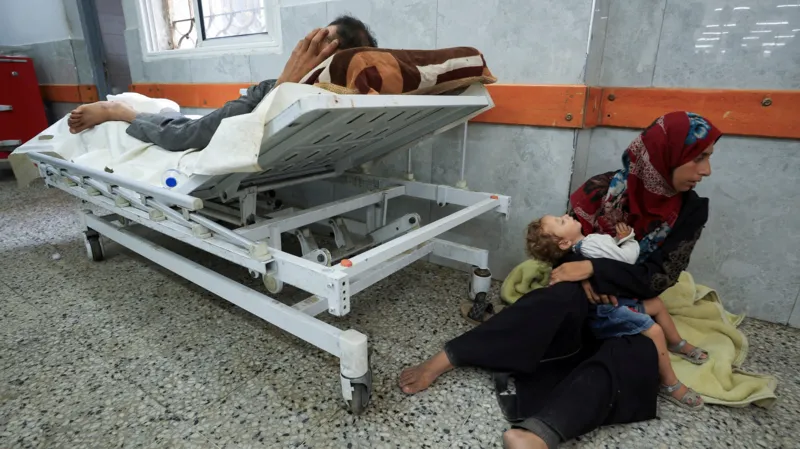
At least 39 Palestinians have died while attempting to access humanitarian aid in Gaza, according to medical reports from al-Shifa, al-Quds, and Nasser hospitals. The casualties occurred near distribution points run by the Gaza Humanitarian Foundation (GHF)—a controversial, US- and Israel-backed aid program operating inside Israeli military zones.
Deadly Incidents Across Gaza
- 25 people were killed overnight near a GHF convoy in the Netzarim Corridor, Gaza City.
- 14 more were killed near GHF’s Rafah site, said officials at Nasser Hospital in Khan Younis.
The Hamas-run Civil Defence and multiple eyewitnesses reported that Israeli forces opened fire, with some victims also believed to have been crushed by aid lorries or shot by Palestinian gunmen.
“They shoot and throw missiles at us, the gangs attack us—everyone attacks us for a bag of flour,” said a distressed resident.
The Israeli military (IDF) confirmed troops fired “warning shots” toward individuals they deemed a threat and emphasized that the Netzarim Corridor remains an active combat zone.
“We are reviewing reports regarding individuals injured,” the IDF stated.
Eyewitness Accounts & Videos Reveal Chaos
Video footage shared by Israeli anti-war activist Alon Lee-Green, verified by the BBC, shows chaotic scenes of hundreds of young men scrambling for food at the Tal al-Sultan distribution site in Rafah.
“This is what starving people look like, risking their lives for food,” Green wrote on X.
The footage underscores what aid workers describe as an aid system on the brink of collapse.
GHF Under Fire from Humanitarian Groups
Despite GHF claims that over 43,000 food parcels were distributed “without incident”, hospitals and aid groups report daily fatalities near their centers.
- Since GHF began operating on 26 May, 223 people have been killed while seeking aid, with 57 deaths reported on Wednesday alone.
- The UN and international aid agencies have refused to cooperate with the GHF, accusing it of violating humanitarian principles of neutrality, independence, and impartiality.
“No one should be forced to risk their lives to receive aid,” said UN spokesperson Farhan Haq.
The UN World Food Programme (WFP) said it managed to dispatch 59 aid trucks to northern Gaza, but many were intercepted and looted by desperate civilians before reaching distribution points.
Worsening Humanitarian Crisis
Gaza’s 2.1 million residents are facing catastrophic hunger after nearly three months of Israeli blockade, partially lifted only on 19 May. Community kitchens, like one in Nuseirat, are currently preparing 259,000 meals per day, but this is a fraction of what’s needed.
A local father said his child had not eaten in two or three days, while others expressed desperation:
“Our children are pushed from one community kitchen to another. The situation is dire. We call on the world to demand a ceasefire.”
Background: Israel-Gaza War Timeline
The current violence stems from the October 7, 2023 Hamas-led attack on southern Israel that left 1,200 dead and 251 kidnapped. In response, Israel launched an expansive military campaign in Gaza.
As of June 2025:
- Over 55,104 Palestinians have been killed, according to Gaza’s health ministry.
- Access to food, medicine, and internet remains severely restricted.
- Medical facilities are overwhelmed and under threat, including Gaza’s main hospitals.
Conclusion: Calls for Ceasefire Intensify
With rising civilian casualties, a faltering aid mechanism, and failing infrastructure, international pressure is mounting for a ceasefire and the creation of a neutral, safe humanitarian corridor in Gaza.