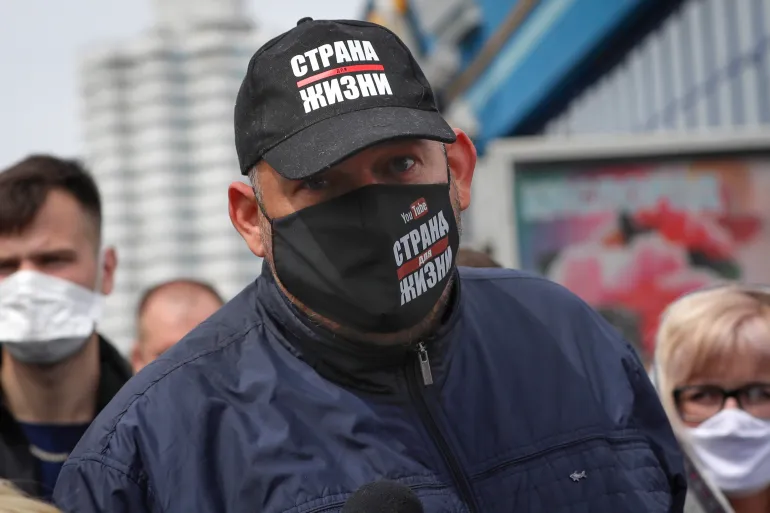
Prominent Belarusian opposition leader Siarhei Tsikhanouski has been released from prison after spending five years in detention on politically motivated charges. His wife, Svetlana Tsikhanouskaya, confirmed his release in a social media post, calling it a moment of “indescribable joy.”
“My husband Siarhei is free!” she wrote on X (formerly Twitter), sharing a video of the couple embracing in Lithuania’s capital, Vilnius. She expressed gratitude to US President Donald Trump, special envoy Keith Kellogg, and European allies for their roles in facilitating the release.
Tsikhanouski, a 46-year-old blogger and vocal critic of President Alexander Lukashenko, was arrested in 2020 after launching a grassroots campaign to challenge the long-standing leader. His popular slogan, “Stop the cockroach,” became a rallying cry for protesters, many of whom waved slippers—a reference to squashing a cockroach.
He was sentenced in December 2021 to 18 years in prison for charges including organizing mass unrest and inciting hatred, widely condemned by international human rights groups as fabricated. In 2023, an additional 18-month sentence was added for alleged insubordination.
According to a spokesperson for Tsikhanouskaya, 14 detainees were released and transported to Lithuania. This group includes five Belarusian nationals, three Polish citizens, two Latvians, two Japanese, and one Swede. Among them is Igor Karnei, a former Radio Free Europe/Radio Liberty journalist detained in 2023.
The surprise release followed a high-level diplomatic meeting between President Lukashenko and US envoy Keith Kellogg—the first of such scale in years. Lithuania’s foreign ministry confirmed the group had arrived safely and were receiving medical and psychological support.
Push for More Political Prisoner Releases
Despite the emotional reunion, Tsikhanouskaya stressed that the fight is not over. Over 1,150 political prisoners are still detained in Belarus, according to human rights group Viasna.
“We’re not done,” she said. “All must be released.”
Belarus remains the only European country that still enforces the death penalty. Since Lukashenko took power in 1994, opposition parties have been banned, and dissent has been violently suppressed.
The release of Tsikhanouski may signal a potential thaw in relations between Belarus and the West, though observers caution it may also be a strategic gesture amid growing geopolitical tensions.