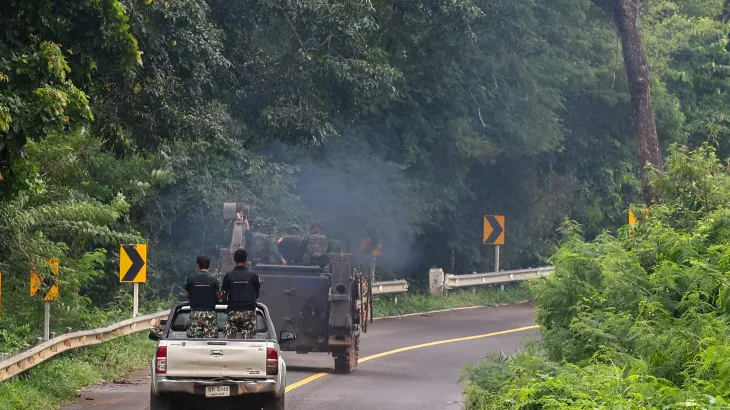
Intense artillery fire broke out along the Thailand-Cambodia border early Sunday, killing at least 33 people and displacing over 200,000, just hours after U.S. President Donald Trump announced that leaders from both countries had agreed to negotiate a ceasefire.
The clashes, the worst in more than a decade, come amid a long-standing territorial dispute involving historic temple sites like Preah Vihear and Ta Moan Thom along the 817-kilometre border. Tensions flared once again Thursday and have since escalated rapidly, despite diplomatic pressure from the U.S.
Trump, who is currently on a golf visit in Scotland, had spoken with Cambodian Prime Minister Hun Manet and Thailand’s acting Prime Minister Phumtham Wechayachai late Saturday. He claimed both leaders were “looking for an immediate ceasefire and peace,” and even placed tariff negotiations on hold pending the cessation of hostilities.
However, by Sunday morning, both sides exchanged heavy artillery across contested zones. Each government blamed the other for the renewed attacks. Cambodia’s Ministry of National Defence accused Thailand of shelling temple sites and launching ground assaults, while the Thai military said Cambodian rockets targeted civilian homes.
Al Jazeera’s Tony Cheng, reporting from Thailand’s Surin province, said artillery exchanges were ongoing with “heavy barrages from the Thai side and some return fire from Cambodia.”
The fighting has forced mass evacuations from border communities in both nations. Authorities report that over 200,000 people have been relocated to shelters, with facilities offering only basic necessities such as food, water, and bedding.
Local reactions reflected growing exhaustion and desperation.
“If Thailand agreed to stop fighting, both countries could live in peace,” said Sreung Nita, a student in Phnom Penh.
“It’s great that America is insisting on the ceasefire because it would bring peace,” added Thavorn Toosawan, a resident of Sisaket, Thailand.
UN Secretary-General António Guterres joined the call for an immediate ceasefire and urged both governments to resume negotiations for a long-term resolution.
Cambodia confirmed its endorsement of the ceasefire initiative. However, Thailand insisted talks couldn’t proceed until Cambodian forces halted attacks on Thai civilians—an accusation Phnom Penh has firmly denied.
Foreign ministers from both nations are expected to meet in the coming days, coordinated by U.S. Secretary of State Marco Rubio and Cambodian Foreign Minister Prak Sokhonn.
The territorial conflict over Preah Vihear dates back decades. Although the International Court of Justice awarded the 11th-century temple to Cambodia in 1962, tensions flared in 2008 after Cambodia sought to designate it as a UNESCO World Heritage Site. Skirmishes since then have claimed dozens of lives and inflamed nationalist sentiments on both sides.
For now, the border remains volatile with no clear path to de-escalation, and civilians caught in the crossfire are left hoping international diplomacy can deliver peace where political will has failed.