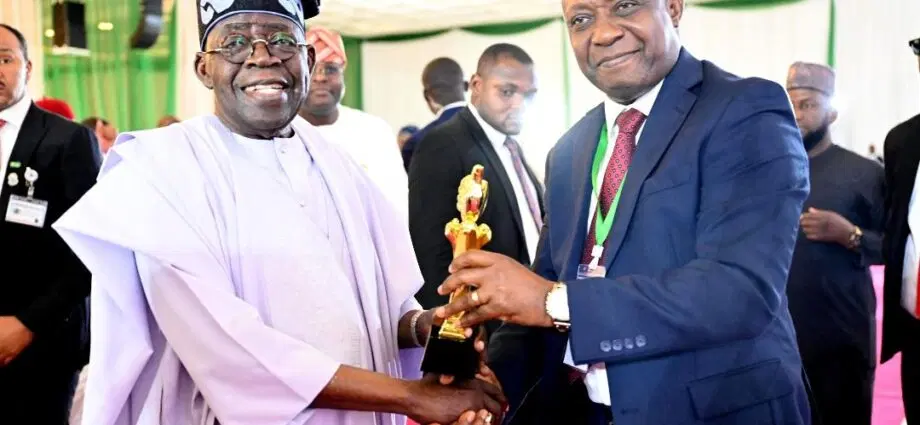
President Bola Ahmed Tinubu has endorsed several reform proposals from the Nigeria Guild of Editors (NGE) to rescue the country’s struggling media industry, including corporate tax relief, Value Added Tax (VAT) exemption, and affordable financing options for media organisations.
Speaking while declaring open the 21st All Nigeria Editors Conference (ANEC) at the Presidential Villa, Abuja, Tinubu expressed support for the editors’ request for government-backed reliefs and loans through the Bank of Industry (BoI) to ease operational burdens in the sector.
“I’ve listened to your requests — corporate tax relief, VAT exemption, affordable loans, and grants for digital development. As your President, I endorse your proposals,” Tinubu said.
He added humorously, “Your request is in my pocket,” drawing laughter from the audience.
Call for Responsible Journalism
The President, however, urged editors to uphold patriotism, fairness, and responsibility in their reporting, warning that misinformation could threaten national unity and democratic stability.
“Criticise the government if you must, but do so with knowledge and fairness. Let your aim be to help build, not destroy,” Tinubu said, urging editors to serve as patriotic gatekeepers of truth and national cohesion.
He commended the historic role of the Nigerian media in fighting military dictatorship and defending democracy, acknowledging the sacrifices of journalists who endured arrests and intimidation in past eras.
Tinubu also reflected on the initial backlash that greeted his economic reforms, such as foreign exchange liberalisation and subsidy removal, saying they were necessary to fight corruption and rebuild the economy.
“When I removed the arbitrage to stop corruption and strengthen the economy, you all dealt with me. But today, we should celebrate that progress is being made. The days of darkness are ending,” he said.
Economic Recovery and Media Resilience
Reaffirming his administration’s commitment to macroeconomic stability and citizens’ welfare, Tinubu said reforms were yielding positive results despite short-term challenges.
He appealed to the media to report these efforts responsibly, noting that “how Nigeria is projected to the world matters.”
“Let us choose clarity over confusion, responsibility over recklessness, and hope over despair,” Tinubu urged.
NGE Raises Alarm Over Industry Distress
Earlier, NGE President Eze Anaba decried the worsening financial state of the Nigerian media, revealing that rising operational costs have crippled many organisations.
He said the price of a ton of newsprint had surged to between ₦1.3 million and ₦1.4 million, leaving newsrooms struggling to stay afloat.
“The media today is distressed. Many organisations cannot pay salaries — not for lack of competence, but because production costs are unbearable,” Anaba lamented.
The NGE proposed:
- 5–10 years of corporate tax relief for media companies,
- VAT exemptions on essential inputs,
- Tax credits for corporations advertising in Nigerian outlets, and
- Low-interest loans via the Bank of Industry and Development Bank of Nigeria.
The Guild also called for a Media Innovation Fund to support digital transformation and data journalism.
“When the press thrives, democracy breathes. When the press is stifled, democracy suffocates,” Anaba warned.
Editors’ Role in Democracy — Uzodimma
Delivering the keynote address, Governor Hope Uzodimma of Imo State stressed that editors must act as catalysts, not bystanders, in shaping Nigeria’s democratic future ahead of the 2027 elections.
“You are not spectators in 2027; you are catalysts. The narratives you shape will determine whether Nigerians see the elections through a tribal lens or a shared national destiny,” he said.
He cautioned against sensationalism and urged journalists to promote accuracy, verification, and context.
“When every disagreement is framed as a crisis, you feed polarisation and deepen distrust,” he warned.
FG Reaffirms Commitment to Press Freedom
In his remarks, Minister of Information and National Orientation, Mohammed Idris, praised the President’s engagement with the media, describing it as a historic first.
He assured editors that the administration’s modernised tax reforms would strengthen public infrastructure while ensuring media-specific reliefs were implemented soon.
“Like the press under dictatorship, President Tinubu resisted oppression as Lagos Governor. He understands that an independent press is not a foe but the foundation of democracy,” Idris said.
He added that no broadcast station has been shut down for critical reporting under Tinubu’s government and announced that UNESCO had chosen Nigeria to host the global Media and Information Literacy Institute — a nod to the administration’s support for press freedom.
“The best editor is the one who knows what not to publish. Let us tell Nigeria’s story with balance, truth, and belief in our future,” Idris concluded.