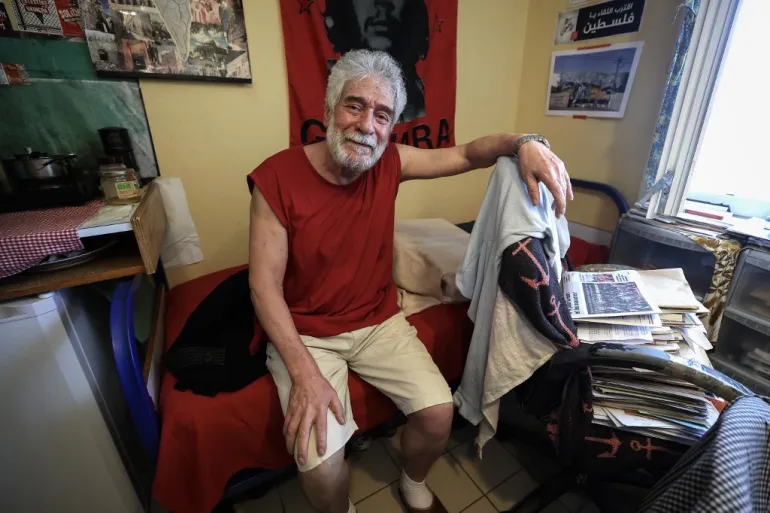
Pro-Palestinian Lebanese fighter Georges Ibrahim Abdallah has been released from a French prison after serving over 40 years for his involvement in the 1980s killings of two diplomats. His return to Lebanon was met with celebration and political symbolism, as supporters gathered in Beirut to welcome him home.
Abdallah, 74, was freed early Friday morning from Lannemezan prison in southern France following a ruling by the Paris Court of Appeal. The court made his release conditional on his permanent expulsion from French territory.
Upon arrival at Beirut International Airport, Abdallah was greeted in the VIP lounge by family members. Nearby, dozens of supporters chanted slogans and waved Palestinian and Lebanese Communist Party flags, celebrating what many see as a victory for resistance movements.
🚗 Around 3:40am French time, a six-vehicle convoy was seen departing the prison facility, according to AFP reporters. Abdallah then boarded a flight to Lebanon, completing a journey that closed one of France’s longest-running political imprisonments.
In 1987, Abdallah was convicted in France for aiding the killings of U.S. military attaché Charles Robert Ray and Israeli diplomat Yacov Barsimantov in Paris. He was eligible for parole for decades, but pressure from the United States, which acted as a civil party in the case, delayed his release.
His lawyer, Jean-Louis Chalanset, told AFP that Abdallah appeared “very happy” before leaving France, though he acknowledged the difficult geopolitical context in the Middle East, particularly for Palestinian and Lebanese populations.
Abdallah is the founder of the now-defunct Lebanese Revolutionary Armed Factions. French authorities discovered weapons and communications gear in his apartment at the time of his 1984 arrest. Despite spending four decades behind bars, Abdallah never expressed regret, describing himself as a “militant” fighting for the rights of the Palestinian people, not a criminal.
The French court praised his prison conduct, noting in a 2024 ruling that Abdallah presented “no serious risk of committing future terrorist acts.”
With his return to Beirut, Abdallah becomes a renewed symbol of resistance for many across the Arab world amid escalating regional tensions.