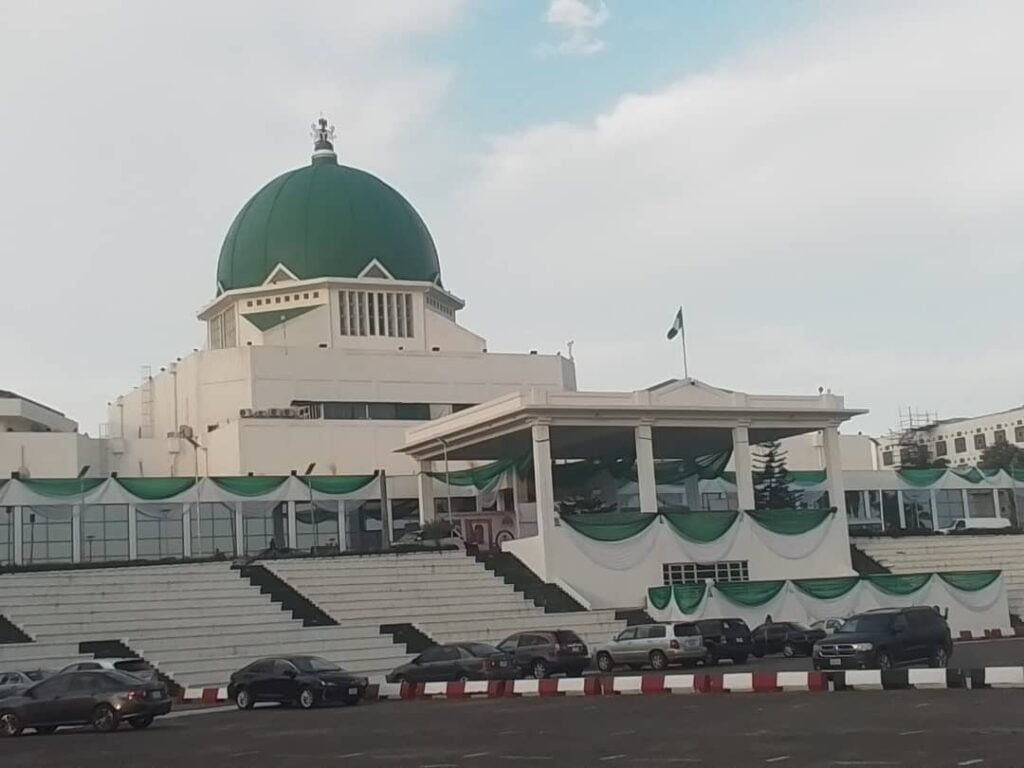
The National Assembly has approved President Bola Tinubu’s request to borrow ₦1.15 trillion from the domestic debt market to fund the 2025 budget deficit — marking the completion of the government’s fiscal financing plan for the year.
Both chambers — the Senate and the House of Representatives — gave their approval on Wednesday following the consideration of reports from their respective debt management committees.
Senate Approval and Details
The Senate’s decision followed the adoption of a report by the Senate Committee on Local and Foreign Debt, chaired by Senator Wamakko Magatarkada Aliyu (APC, Sokoto North).
According to the committee, the 2025 Appropriation Act sets total government expenditure at ₦59.99 trillion, representing a ₦5.25 trillion increase over the original ₦54.74 trillion proposal. This adjustment widened the budget deficit to ₦14.10 trillion, of which ₦12.95 trillion had already been approved for borrowing.
The newly approved ₦1.15 trillion fills the remaining funding gap, ensuring the government’s ability to implement all planned projects and programmes under the 2025 fiscal framework.
President Tinubu, in a letter to the Senate, said the additional borrowing was vital “to bridge the funding gap and ensure full implementation of government programmes and projects under the 2025 fiscal plan.”
Legislators Defend Borrowing
During the plenary, Senator Sani Musa (APC, Niger East) said the borrowing was “necessary to keep the budget functional,” while Senator Adetokunbo Abiru (APC, Lagos East) clarified that it would not worsen Nigeria’s debt burden since it had already been captured in the deficit plan.
“This is more of a compliance issue to ensure Nigeria meets its 2025 obligations and avoids default on maturing debts,” Abiru explained.
Senator Adams Oshiomhole (APC, Edo North) also defended the move, insisting there was “nothing wrong with borrowing if it is well-structured and used to address unemployment and infrastructure gaps.”
Rising Debt Concerns
The approval comes amid growing public anxiety over Nigeria’s rising debt, which the Debt Management Office (DMO) estimated at over ₦152.4 trillion as of mid-2025.
While critics warn that continuous borrowing could push Nigeria toward unsustainable debt levels, lawmakers and government officials maintain that strategic loans are crucial for stabilizing the economy and financing critical projects.
House of Representatives Backs Proposal
The House of Representatives also approved the ₦1.15 trillion borrowing following the consideration of a report by the Committee on Aids, Loans, and Debt Management, chaired by Abubakar Nalaraba (APC, Nasarawa).
Presenting the report, Nalaraba urged the House to approve the borrowing “to close the unfunded deficit gap created by the increase in the 2025 budget size beyond previously approved revenue and borrowing limits.”
In his letter to the House, President Tinubu noted that the adjustment was in line with the Fiscal Responsibility Act (FRA) 2007, which requires legislative approval for all new government loans.
“It is necessary to increase the domestic borrowing limit by ₦1.15 trillion to close the gap created by the revised 2025 budget size,” Tinubu wrote.