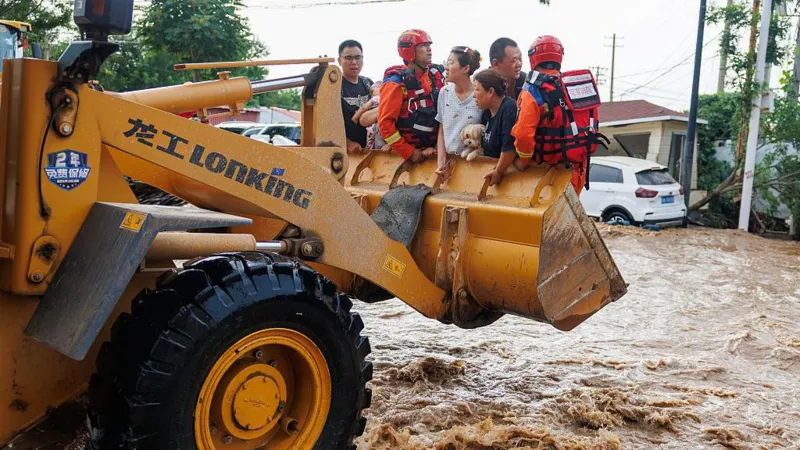
At least 30 people have been confirmed dead in Beijing after record-breaking rains unleashed devastating floods across northern China, forcing the evacuation of over 80,000 residents, authorities said.
The heavy downpour also triggered a deadly landslide in Chengde, a city northeast of Beijing, killing eight more people.
Northern China is facing one of its most extreme weather seasons in recent memory, as floods, heatwaves, and landslides strike multiple provinces. Earlier this month, scorching heat baked eastern China, while typhoons battered the southwest.
Xi Jinping Orders ‘All-Out’ Rescue Operations
President Xi Jinping has called for intensified rescue efforts and ordered officials to prepare for “worst-case and extreme scenarios.” He emphasized that no effort should be spared in locating the missing, evacuating at-risk communities, and minimizing casualties.
In response, China has allocated ¥200 million ($28 million) to support flood recovery, including road repairs and infrastructure restoration.
Worst-Hit Areas: Miyun and Huairou
The outskirts of Beijing, particularly Miyun and Huairou districts, bore the brunt of the torrential rain. Videos circulating online show floodwaters submerging roads, with emergency teams navigating chest-deep waters to rescue stranded residents. Power outages have hit more than 130 villages, and dozens of roads have been washed away or damaged.
Drones and helicopters are being deployed to deliver food and emergency supplies to isolated areas.
Desperate Families Await News
Ms. Yang, a resident of Hebei province, shared her distress with BBC Chinese after failing to contact her elderly and ailing parents in Miyun since Sunday. Her relatives, who also care for her eight cats and three dogs, live in a remote village with only ten households. She has turned to social media in hopes that rescuers will reach them soon.
Residents have described how rapidly the disaster struck.
“The flood came rushing in—so fast and suddenly,” said Zhuang Zhelin, a shop owner in Taishitun town near Beijing. “In no time, everything was submerged.”
His neighbor added, “I just ran upstairs and waited, thinking if no one came, we’d be in serious danger.”
Climate Change Behind the Surge in Disasters
China is no stranger to summer flooding, with a notable tragedy in 2012 claiming 79 lives in Beijing alone. But this year, the scale and frequency of extreme weather events are raising new alarms.
In recent weeks:
- Typhoon Wipha caused floods in Shandong, killing two and leaving ten missing.
- A landslide in Ya’an city killed three people.
Experts warn that climate change is increasing the severity of such natural disasters, putting pressure on China’s economy and its vital agriculture sector.
According to the emergency management ministry, natural disasters have already cost China ¥54.1 billion ($7.5 billion) in the first half of 2025—more than 90% due to flooding alone.